
Apple’s newest patent application for an “Electronic Device with Glass Enclosure” outlines an iPhone that looks and feels like a single slab of glass, advancing a long-standing ambition to eliminate seams and redefine how users interact with a smartphone.
Filed on March 14, 2025 and published August 7, 2025, the application details a device whose front, back, and peripheral sides all present touch-sensitive, viewable display areas for a seamless 360-degree interface.
The Vision: A Seamless Glass iPhone
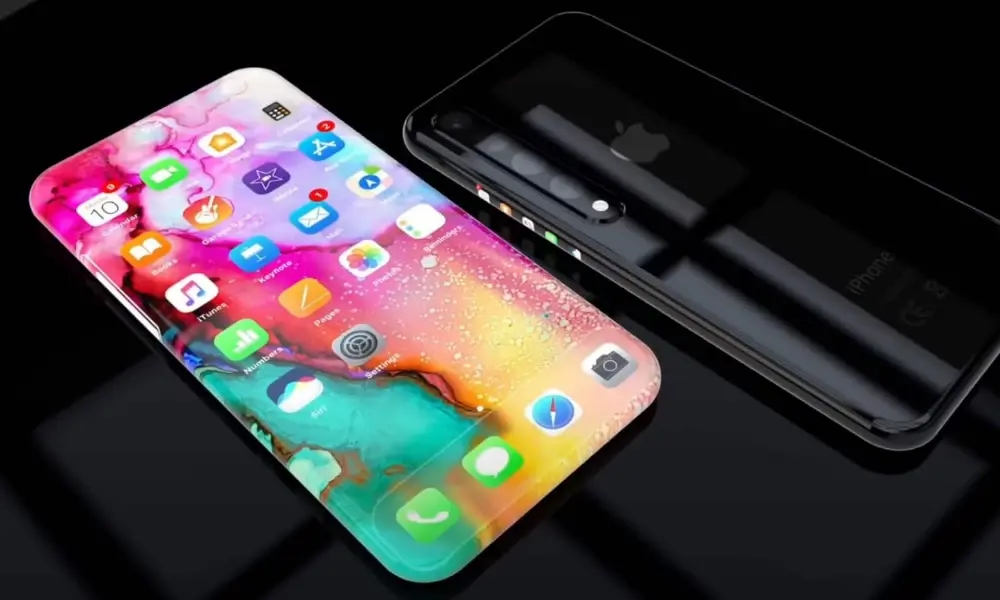
The filing describes a six-sided glass enclosure formed from two glass members that together appear “visually and tactilely seamless,” giving the impression of being made from a single piece of glass even though it’s constructed from multiple pieces joined with precision.
Inside, a flexible touchscreen display is positioned adjacent to at least portions of each of the six sides, enabling graphical output and touch input across the front, sides, and back of the device. Apple explicitly envisions content that wraps continuously over edges, with icons and UI elements moving across surfaces like a “ribbon‑like user interface” that encircles the device.
Multi-Surface Interaction and Dynamic UI
Apple’s documentation proposes side and back surfaces that are touch and/or force sensitive, effectively turning every face into an input surface for controls like Wi‑Fi, airplane mode, and volume, no longer confined to a single front panel. The UI may dynamically rotate and “switch sides” as the device is flipped, presenting primary content where it’s most useful and minimizing accidental touches, aided by squeeze-sensitive regions that could replace mechanical buttons with solid-state, haptic feedback areas. In some embodiments, speakers and microphones would automatically switch to the best-positioned units depending on how the device is held, thereby preserving a seamless aesthetic without sacrificing functionality.
Manufacturing the Impossible
Apple acknowledges formidable engineering challenges in realizing a glass-encased, wraparound-display device, including shaping thin, durable glass with tapered edges, ensuring robust display encapsulation across curves, and integrating acoustic openings without disrupting the enclosure’s continuity.
The enclosure may be formed from two interlocking glass pieces or a single hollow glass body with an aperture for inserting internal components, each demanding tight tolerances and advanced bonding techniques.
A Decade of Iteration
This 2025 application builds on years of Apple research into wraparound displays and glass housings, including earlier patents that explored transparent or glass enclosures and flexible displays spanning multiple faces of a device. Prior art has even described UI behaviors where content and controls migrate over edges, expanding usable surface area beyond a single flat front panel, an idea Apple has been refining since at least the early 2010s.
Corning Partnership: Materials at Scale
Scaling such a design depends on advances in precision glass manufacturing, a backdrop to Apple’s August 6, 2025 announcement committing $2.5 billion to produce 100% of iPhone and Apple Watch cover glass at Corning’s Harrodsburg, Kentucky facility and to establish a joint Apple-Corning Innovation Center for next‑generation glass technologies.
Corning will dedicate the entire plant to Apple, expanding the workforce and creating what Apple calls the world’s largest and most advanced smartphone glass production line, which is an investment aimed squarely at pushing the limits of durability, shaping, and throughput.
Commercial Outlook: Vision, Not Imminence
Despite the patent’s detail and the scale of related supply chain investments, industry coverage stresses that an all‑glass, wraparound iPhone remains years from mass production due to the complexity of flexible displays, encapsulation, antenna performance in glass-heavy structures, and manufacturing yield. Near‑term product expectations focus instead on the upcoming iPhone 17 family as Apple’s next design evolution while R&D continues toward more radical, seamless concepts.
Why It Matters
- 360-degree interface: A continuous, wraparound canvas enables glanceable side info, contextual controls, and new app paradigms beyond a single front screen.
- Solid-state ergonomics: Touch/force‑sensitive sides and squeeze regions reduce mechanical parts and allow the UI to adapt to orientation and grip.
- Materials leadership: The Corning partnership accelerates advances in toughened, precisely formed glass essential for multi-surface device architectures.
Apple’s 2025 patent crystallizes a coherent trajectory: a six‑sided glass iPhone whose flexible display and input systems span every surface, merging object and interface into a unified, adaptive whole ambitious today, but increasingly plausible as materials science and manufacturing platforms mature.
Discussion
Start the conversation
No comments yet
Be the first to share your thoughts on this article. Your insights could spark an interesting discussion!