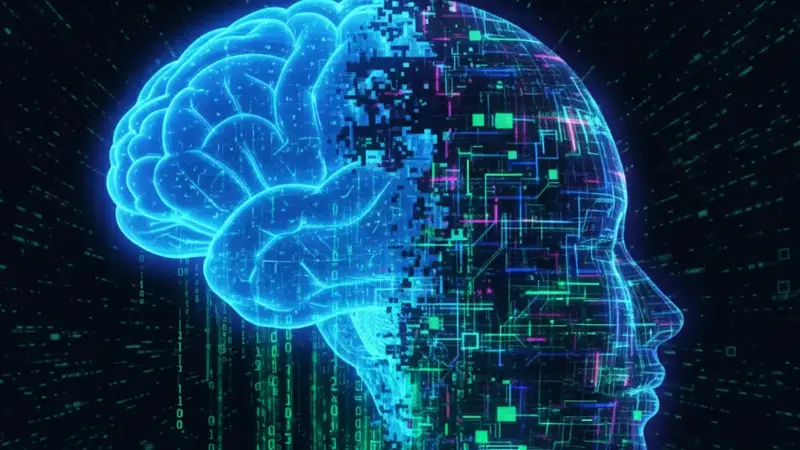
Ever thought about what would happen if your consciousness could run like code?
Picture this: you wake up, and your body isn’t there. You look down, but your hands are gone, replaced by streams of light and data. Your thoughts are faster, clearer, unlimited but are you still really you?
This is the vision of mind uploading , transferring a human mind into a digital world. It’s part science, part philosophy, and something that Hollywood has been exploring for decades. Movies like Tron, The Matrix, and Ready Player One give us a glimpse of what it might feel like to live as code, but the reality is far more complicated, and far closer than you might think.
What “Digitalizing a Human” Really Means
When people talk about “uploading the mind,” they usually mean one of three things:
- Whole-Brain Emulation (WBE): Scanning every neuron and connection in the brain to create a digital copy that behaves like the original.
- Digital Twin: An AI model trained on your behavior, speech, and memories. It acts like you but isn’t conscious.
- Consciousness Transfer: The idea of moving your subjective awareness into a digital space, the stuff of sci-fi.
In movies like Tron, characters literally enter a digital universe and exist as programs. The Matrix imagines a simulated reality indistinguishable from the real world. These stories explore what happens when identity and consciousness are separated from the body , these are exactly the questions science is grappling with today.
Why It’s So Hard to do it
Our brain has about 86 billion neurons and roughly 100 trillion connections. Every thought, memory, and
emotion is a pattern within that network.
We’re starting to map small pieces of it:
- The Blue Brain Project simulates tiny sections of a rat’s cortex neuron by neuron.
- Neuralink and other brain-computer interfaces are learning to read and stimulate brain signals to restore movement or speech.
- The Human Connectome Project is mapping how different brain regions communicate.
But the human brain is orders of magnitude larger and more complex. To truly upload a mind, we’d need to scan every synapse, every neuron, and even molecular states and then run a computational model powerful enough to simulate trillions of interactions in real time.
Even if we could do all that, would the copy be conscious? Would it feel like you?
The Consciousness Question
This is where it gets philosophical. Imagine a perfect digital copy of you that claims your memories, personality, and fears. Is it really you or just a copy?
Functionalists argue that consciousness depends on patterns of information, not the material itself. Physicalists say that the biology of neurons might be essential for subjective experience.
Movies often dramatize this dilemma. In Transcendence, Johnny Depp’s character uploads his consciousness, but the movie questions whether the digital version truly retains his humanity. In Ready Player One, people live as avatars, but their “real selves” are still tethered to their bodies.
There’s no experiment yet to settle this, we can never be sure if the digital version truly experiences existence or just imitates it.
Barriers and Challenges
Even before philosophical questions, there are huge technical challenges:
- Scanning: Current imaging can’t capture every connection without destroying the brain.
- Data Storage: A human connectome could require exabytes of storage.
- Simulation Power: Modeling a brain in real time would require computing resources beyond anything currently available.
- Validation: Even if it runs perfectly, how do we know the mind is “real” and not a sophisticated replica?
It’s a leap from movies to reality, but the first steps are already being taken.
Ethics, Identity, and Society
Assume we could upload minds, who owns your digital self? You? The company that runs the servers? What if multiple copies exist? What rights would they have?
Hollywood often explores these ethical dilemmas: The Matrix raises questions about autonomy and consent, Tron about identity and control, and Black Mirror episodes like “San Junipero” explore living beyond your biological lifespan.
Digital immortality could change how we define life, death, and personal identity.
The Future: Part Sci-Fi, Part Science
Full mind uploading is still a dream, but parts of it are emerging. Brain-computer interfaces restoring movement and speech. We also have AI assistants that can mimic people after they’re gone as well as Digital “twins” that carry some aspects of personality into virtual worlds.
The path to digital immortality might not be an instant upload. It could emerge gradually, neuron by neuron, as humans and machines merge. Movies give us imagination, but reality will be incremental, messy, and unpredictable.
Why It Matters
Mind uploading isn’t just about escaping death, even though it might seem like that, but the Consciousness Question still remains, is it really you?, does it really mean surviving death?
Maybe it’s about understanding what it means to be conscious, alive, and human. We are in an age where AI is the current hot topic around the world and many prominent industries and tech companies have already dived into this AI race but its because we are still learning about it , making new breakthroughs along the way. I think we are moving towards a future where it will eventually become a more normal, daily companion of humans. After that , we may enter the era where we might make a breakthrough in digitalizing ourselves, it may be the next big thing.
Before we can digitize ourselves, we have to define the self. Movies and science give us pieces of the puzzle, but the rest is up to exploration, ethics, and imagination.
Whether our future exists in neurons, servers, or virtual worlds, the mind remains the most mysterious frontier we’ve ever tried to explore and the explorer is still us.
Discussion
Start the conversation
No comments yet
Be the first to share your thoughts on this article. Your insights could spark an interesting discussion!