
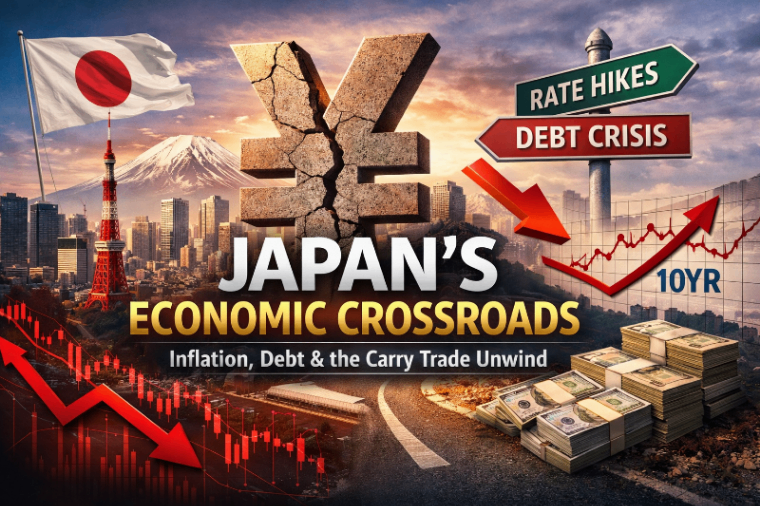
For more than thirty years, Japan occupied a unique and stabilizing role in the global financial system. While other economies cycled through booms, busts, and inflation scares, Japan remained defined by low growth, low inflation, and near-zero interest rates. This consistency turned the yen into the world’s preferred funding currency and Japanese government bonds into the ultimate symbol of monetary stability.
That era is now being tested.
Japan today finds itself confronting a convergence of forces that rarely appear together: persistent inflation, a weakening currency, and the heaviest public debt burden in the developed world. None of these challenges is unprecedented in isolation. What makes the current moment significant is that they are unfolding simultaneously, in a global environment where other major central banks are also constrained.
The question markets are increasingly asking is not whether Japan will raise rates again, but whether the global system built around Japan’s monetary exceptionalism can adapt when it does.
From Deflation to Inflation: A Fundamental Shift
For decades, Japan’s central bank struggled to generate inflation. Negative rates, quantitative easing, and yield curve control became permanent fixtures rather than emergency tools. Investors internalized a simple belief: Japanese rates could not rise in any meaningful way.
That belief is now under strain.
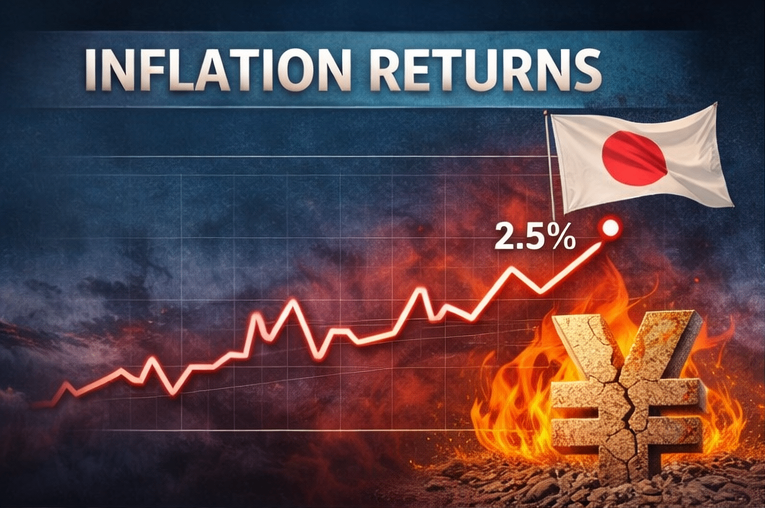
Inflation in Japan has climbed to around 2.5 percent and shows signs of persistence. Unlike in the United States or Europe, where strong domestic demand and wage growth played a central role, Japan’s inflation has been heavily influenced by external factors, most notably currency depreciation. A weaker yen raises the cost of imported energy, food, and industrial inputs, feeding directly into consumer prices.
When Bank of Japan Governor Kazuo Ueda warned that a weak yen could influence underlying inflation, he was acknowledging a critical vulnerability. Currency-driven inflation leaves policymakers with limited flexibility. Allowing the yen to slide risks embedding inflation expectations, while tightening policy risks undermining growth and fiscal sustainability. This is the policy dilemma at the heart of Japan’s current predicament.
The Fiscal Constraint: When Debt Meets Rising Rates
Japan’s government debt stands at roughly 260 percent of GDP, a level unmatched among advanced economies. For years, this figure appeared less threatening than it might elsewhere, largely because interest rates were near zero and the debt was domestically held. Rising rates change that arithmetic.
Even modest increases in borrowing costs significantly raise debt servicing expenses. Estimates suggest that each one-percentage-point rise in average funding costs adds roughly ¥13 trillion to annual interest payments. At higher rates, interest spending could absorb a substantial share of government revenue, crowding out social spending, defense, and public investment.
Yet Japan cannot rely indefinitely on financial repression. Holding rates artificially low risks further yen depreciation, which in turn fuels inflation and erodes household purchasing power. The result is a feedback loop in which monetary and fiscal objectives pull in opposite directions.
This does not imply imminent fiscal crisis. Japan benefits from long debt maturities, a large domestic investor base, and strong institutional credibility. However, it does mean that the margin for policy error is narrowing.

Markets Adjust: The Psychology of Regime Change
Perhaps the most important shift is not occurring in official policy but in market psychology.
For much of the past three decades, investors treated Japanese government bonds as an anomaly, low yielding, but stable and predictable. They were less an investment than a building block for global portfolios. That perception is changing.
As inflation persists and policy normalization continues, investors increasingly expect higher yields. Bond prices, which move inversely to yields, have come under pressure. This dynamic can become self-reinforcing: falling prices validate expectations of further losses, encouraging additional selling. Such feedback loops are common during transitions between monetary regimes. They do not require panic; they require only a collective reassessment of what “normal” looks like.

The Carry Trade and Its Global Reach
The implications extend far beyond Japan’s borders. For decades, the yen has served as the backbone of the global carry trade, borrowing cheaply in yen to invest in higher-yielding assets elsewhere. This strategy became embedded not only in hedge funds but also in pension funds, insurance companies, and corporate balance sheets.
As long as the yen remained weak or stable and volatility was low, the trade appeared safe. However, when the currency strengthens or interest rate differentials narrow, positions must be reduced. Because these trades are often leveraged, adjustments can be rapid and correlated across markets.
This is why analysts warn of a potential “carry trade unwind.” It is not a single event, but a process in which rising volatility forces global investors to reassess leverage, risk, and funding assumptions simultaneously.

A World Without an Easy Backstop
Compounding the risk is the absence of an obvious global safety net. In past episodes of market stress, central banks could ease policy aggressively to restore confidence. Today, that option is limited. Inflation remains above target in most advanced economies, constraining the Federal Reserve and the European Central Bank. Japan, facing its own inflation pressures, cannot revert to ultra-loose policy without consequence.
This does not mean markets are doomed to crisis, but it does mean that volatility may persist longer than investors have grown accustomed to. The expectation of rapid central bank intervention has been deeply ingrained; its erosion represents another quiet regime shift.
What to Watch: Signals, Not Headlines
Markets are now focused on several key indicators. Bank of Japan policy meetings, particularly toward the end of 2025, will be scrutinized for both actions and language. Even modest tightening, if accompanied by hawkish guidance, could prompt sharp market reactions.
Equally important is the behavior of Japanese institutional investors around the fiscal year-end in March. Portfolio rebalancing decisions especially regarding overseas assets, can have outsized effects on global markets, particularly if liquidity is thin.
Currency levels also matter. A sustained move in the yen that challenges the economics of carry trades could accelerate deleveraging, amplifying moves across asset classes.
A Balanced Perspective: Risks and Resilience
It is important to avoid overstating the case. Japan is not on the brink of collapse. Its financial system remains stable, its institutions strong, and its policymakers experienced. The transition away from extreme monetary accommodation has so far been cautious and measured.
However, transitions are inherently unstable. When a system adjusts after decades of continuity, even small changes can have large effects. Japan’s significance lies not in the scale of its rate hikes, but in what they symbolize: the end of an era in global finance.
Conclusion: The End of Exceptionalism
Japan’s challenges mark a broader turning point. A world accustomed to cheap money, low volatility, and reliable backstops is slowly giving way to one defined by constraint, trade-offs, and uncertainty.
Whether this transition unfolds smoothly or turbulently will depend on policy coordination, market discipline, and the pace of adjustment. What is clear is that Japan is no longer merely a passive participant in the global system. It has become an active variable, one capable of reshaping capital flows and risk perceptions worldwide.
The carry trade unwind, if it occurs, will not be a sudden rupture but a gradual realization that the assumptions of the past no longer hold. For investors, policymakers, and observers alike, understanding that shift may prove more important than predicting the next rate move.
Discussion
Start the conversation
No comments yet
Be the first to share your thoughts on this article. Your insights could spark an interesting discussion!