

In recent months, three simple letters - "SIR", have triggered some of the most heated debates in Indian politics. Officially known as the Special Intensive Revision of electoral rolls, the exercise was introduced as a routine administrative measure to ensure cleaner and more accurate voter lists. But on the ground, SIR has grown into a contentious political flashpoint, raising questions about voter rights, institutional credibility, and the future of democratic participation in India. As government bodies defend it as essential for electoral integrity, opposition leaders and civil-society groups warn of mass disenfranchisement, bureaucratic overreach, and potential misuse. Understanding SIR therefore requires going beyond procedure and forms; it demands a close look at how power, politics, and public trust intersect in the world’s largest democracy.
What is SIR
- SIR stands for Special Intensive Revision (or sometimes described as a “special/ intensive revision of electoral rolls / voter lists”) as implemented by Election Commission of India (ECI).
- The stated aim is to verify and update the electoral rolls by removing names that are invalid (e.g. deceased persons, duplicates, fake entries), reconciling inconsistencies, adding eligible new voters, and ensuring the voter list is clean and accurate before upcoming elections.
- In practice, SIR involves requesting voters to submit certain proofs or documentation (identity, address, age, etc.), cross-checking existing records, sometimes house-to-house verification through local officials (like Booth-Level Officers, BLOs), and reconciling the data with older voter lists (including records going back many years).
Why It’s Being Done (Stated Intent)
- According to ECI and proponents, the objective is to ensure electoral integrity by removing fake or duplicate entries, ensuring deceased voters are removed, and preventing electoral fraud. This makes the voter lists more reliable.
- For new or previously unregistered citizens (who are eligible), SIR provides an opportunity to get formally verified and included, enabling them to exercise their right to vote.
- In states preparing for upcoming elections, SIR is seen as a pre-emptive administrative step to avoid “bogus voters” or irregularities that could compromise the fairness of elections.
Who It Affects - Stakeholders and Impacted Groups
- All registered and potential voters. The roll-revision affects people whose names are already on the lists (e.g. to verify continued eligibility) and those eligible but previously unregistered (they may now get added).
- Marginalised and vulnerable communities: Poor, migrant workers, marginalized socio-economic groups, people whose documentation may be incomplete or inconsistent (e.g. address changes, internal migrants, slum dwellers) are particularly affected, due to risk of exclusion if documents are lacking.
- Election officials / BLOs (Booth-Level Officers): who carry out verification, data gathering, form-collection and field-work; the burden of SIR rests heavily on them, especially given time constraints and volume of households to cover.
- Political parties and public institutions: because the final voter lists produced via SIR will influence electoral outcomes, representation, and overall political balance in states.
Controversies, Criticisms, and Problems Associated with SIR
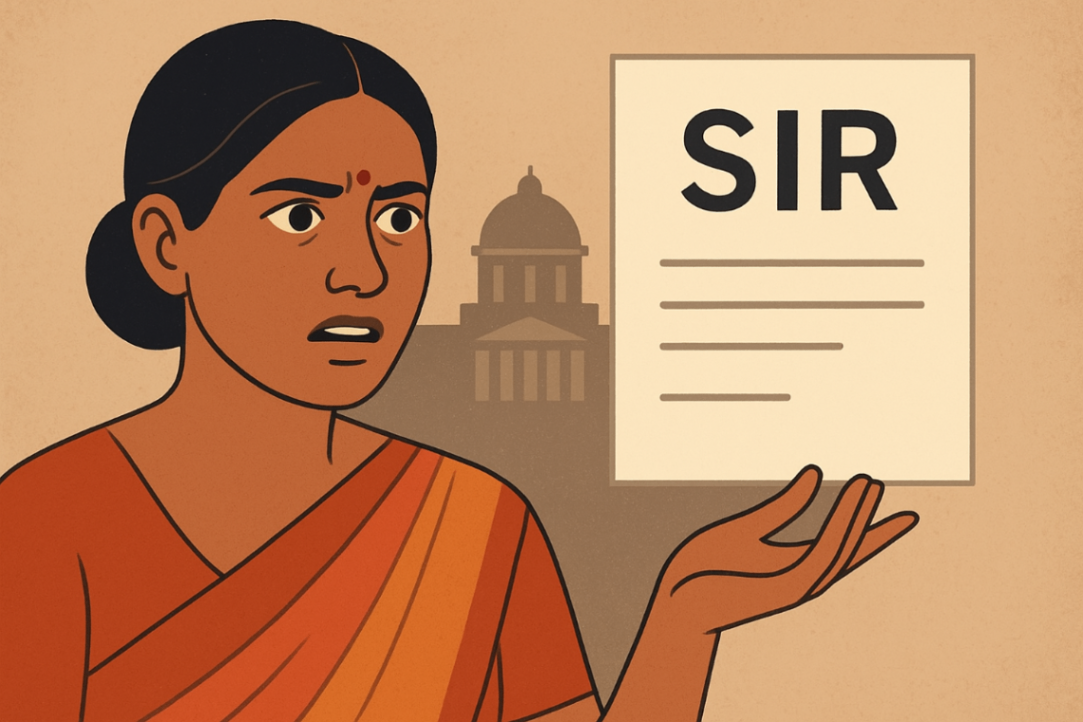
The implementation of SIR in recent months has sparked widespread debate and significant criticism. Key issues:
Accusations of Voter Exclusion / Disenfranchisement
- Several opposition political parties and leaders argue SIR could “snatch voting rights” from millions of citizens, thereby undermining democracy.
- After SIR in some states (notably Bihar), there were reports of large-scale deletion of names from electoral rolls, raising fears that genuine voters, including members of marginalized communities, may be arbitrarily excluded.
- Critics claim that the requirement to produce old documentation (sometimes from 2003 or earlier) is unrealistic for many citizens especially poor, migrant, or rural populations, making their re-verification difficult or impossible.
- Instances of confusion, panic and mistrust have reportedly emerged in states undergoing SIR, with some affected people fearing loss of voting rights or even citizenship status.
Allegations of Political Motive and Partisan Manipulation
- Some see SIR not as a neutral administrative exercise, but as a politically motivated tool to engineer electoral advantage particularly for the ruling alliance (at Centre or state level) by targeting certain voter demographics.
- Leaders from certain states have publicly denounced SIR as a disguised version of other controversial citizenship-related drives (for instance, likening it to the National Register of Citizens NRC), raising fears among minorities and marginalized groups.
- Some political parties and regional governments have either threatened to block SIR or demanded that its scope be clearly limited, expressing concern that the drive could erode constitutional and electoral rights.
Administrative, Technical and Implementation Issues
- Implementation has been called opaque and inconsistent: opposition groups describe SIR as based on “flawed data,” lacking transparency, and susceptible to errors or misuse.
- There have been incidents of fraud or misuse where people are being targeted by cyber-fraudsters: criminals posing as election officials or prompting people to share personal information under the guise of SIR, leading to financial or identity theft.
- The workload on BLOs has reportedly skyrocketed. According to some firsthand (social-media/Internet) reports, many BLOs are under such pressure - targets of hundreds of forms, constant fieldwork, tight deadlines, that there are serious concerns over mistakes, mental stress, and accountability.
- Given the scale and haste (especially ahead of elections), there is doubt whether door-to-door verification and data cross-checks are being done properly, some critics argue the process is rushed, superficial, and prone to oversight.
Social Impact: Fear, Confusion and Erosion of Trust
- In some regions, SIR has triggered fear among citizens, over possible deletion from voter lists, and anxiety around documentation, particularly among economically weaker, migrant, or minority communities.
- The politicization of SIR (with parties publicly calling it a threat to democracy) has led to heightened communal and social tensions in certain states, with voters uncertain about whether to cooperate.
- Some incidents have reportedly been tragic: at least a few cases of distress (including alleged suicides) have been linked by media to panic and radicalization of perception around SIR in certain areas.
Constitutional, Legal and Institutional Dimensions
- The legality and constitutional validity of SIR, especially as implemented ahead of certain state elections has been challenged in courts by opposition parties and civil-society groups.
- As per reporting, during court proceedings regarding SIR’s implementation in a state, the ECI has defended the exercise, calling many of the allegations politically motivated and stating that the revision is lawful and based on fair procedures.
- Critics argue that the timing (close to elections), the demand for strict documentation, and the risk of mass disenfranchisement undermine the core democratic principle of universal adult franchise especially for vulnerable groups.
- On the other hand, proponents say that clean and accurate electoral rolls are essential for credible elections, and SIR is a legitimate exercise under ECI’s mandate to safeguard electoral integrity.
Broader Political Implications
- In states like West Bengal and Tamil Nadu (and earlier in Bihar), SIR has become more than a bureaucratic exercise, it has turned into a political battleground. Parties have invested heavily in shaping the narrative: some calling it necessary for fair elections, others calling it a “voter-purge” tool.
- Given India’s diversity and history of socio-economic and identity-based disparities, aggressive voter-roll revisions and documentation requirements risk biased disenfranchisement which could reshape electoral outcomes to the advantage of certain political blocs or demographics.
- The controversy around SIR feeds into larger debates over citizenship, electoral rights, identity verification and minority protections, similar in spirit to debates around citizenship laws and registers in India.
Why It Matters: Stakes and Consequences
- The outcome of SIR will shape who gets to vote, which in turn may influence the results of upcoming state-level and national elections. If large numbers of voters are excluded (intentionally or unintentionally), it could skew representation.
- For democracy and electoral legitimacy: clean, accurate and inclusive voter lists are central to fair elections. However, if SIR leads to widespread disenfranchisement or erroneous deletions, it could erode public trust in the electoral system and institutions.
- For social justice and representation: historically marginalized communities like poor, migrants, minorities are often most vulnerable to bureaucratic hurdles and documentation requirements. Harsh implementation of SIR might disproportionately affect these groups.
- For institutional credibility: the role of ECI, its impartiality, and the transparency of the process will come under scrutiny. If SIR is perceived as a partisan tool, the very foundation of election governance may be challenged.
SIR: Administrative Necessity or Democratic Risk?
SIR, in principle, is a legitimate exercise: ensuring voter lists are accurate, updated, and free from fraud is essential for credible elections. However, in the context of India’s political dynamics, socio-economic inequalities, and diversity, the implementation of SIR, especially close to elections carries serious risks. The current controversies highlight potential misuse, errors, disenfranchisement and political manipulation.
Whether SIR becomes a tool for cleaning up the electoral database or a weapon for voter suppression depends largely on how transparently, carefully, and fairly the process is conducted with adequate safeguards, public awareness, and accountability.
Given the ongoing debates, court cases and public mobilization, the coming months will be crucial in determining whether SIR strengthens democracy or undermines it.
Discussion
Start the conversation
No comments yet
Be the first to share your thoughts on this article. Your insights could spark an interesting discussion!