
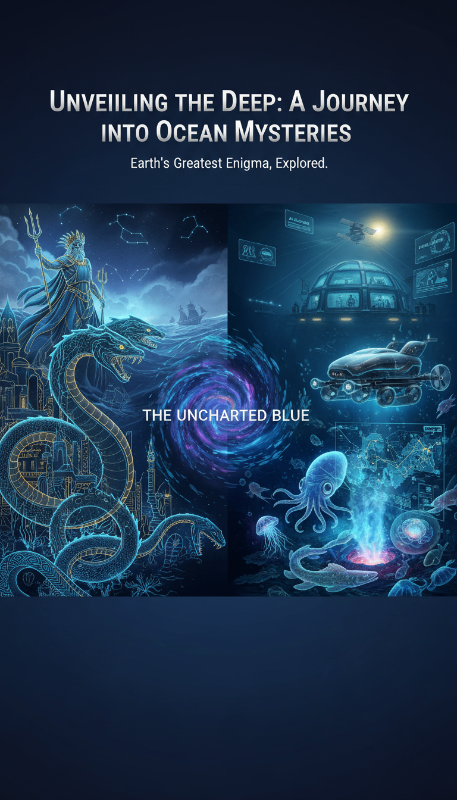
The Uncharted Blue
Imagine knowing more about the desolate plains of Mars than the sprawling ecosystems of our own planet's oceans. An unsettling thought, isn't it? Yet, it underscores a stark reality: the ocean, covering over 70% of the Earth's surface, remains a vast, largely unexplored realm, teeming with secrets that elude our grasp. From bizarre creatures lurking in the crushing darkness of the abyss to whispers of ancient cities swallowed by relentless waves and perplexing disappearances that defy logical explanation, the ocean is, without a doubt, Earth's greatest enigma. We're only just beginning to scratch its surface; a humbling realization, considering that roughly 95% remains a complete mystery to us.
Let's embark on a journey into some of the most captivating ocean mysteries, venturing beyond the shimmering surface to explore what we know, what we think we know, and what lies ahead in our relentless quest to unlock the secrets of the deep.
A Look Back: When the Ocean Was a Mythical Beast
Before the advent of sonar technology and the development of deep-sea submersibles, the ocean was, quite understandably, the stuff of legends. It was a canvas upon which humanity projected its deepest fears and wildest imaginings, a realm governed by capricious gods and lurking monsters.
Think of Poseidon's legendary fury, capable of summoning storms and earthquakes with a mere flick of his trident. Consider the Norse figures of Aegir and Ran, who presided over the seas with a mixture of generosity and terrifying power. Or delve into Japanese folklore, where Ryūjin, the dragon god, ruled the oceans from his opulent underwater palace. These weren't just stories; they were attempts to make sense of a force far greater and more unpredictable than ourselves.
Sailors, those brave (or perhaps foolhardy) souls who dared to traverse the vast expanse, whispered tales of multi-headed Hydras lurking beneath the waves, their venomous breath capable of sinking entire ships. They spoke of the Kraken, an enormous cephalopod whose tentacles could drag vessels to the inky depths, a creature likely inspired by real (and still awe-inspiring) giant squids! And who could forget the enchanting sirens, their alluring songs luring sailors to their doom on rocky shores? (Likely inspired by the more benign, but no less captivating, manatees). The ocean, in essence, was a theater of the mind, populated by creatures born of both fear and wonder.
And then there were the lost worlds: Plato's Atlantis, of course, the archetypal example of a civilization swallowed by the sea. But let us not forget the Celtic legend of Ys, a magnificent city said to have been submerged beneath the waves as punishment for its king's sins. These tales, while fantastical, hinted at a deeper truth: the ocean has the power to erase, to conceal, and to rewrite history itself.
But inevitably, early science began to intrude on the realm of myth.
Aristotle, often hailed as the "father of marine biology," made some surprisingly accurate classifications of marine life, displaying an observational prowess that was centuries ahead of his time. However, even the great thinkers of the past were limited by the technology (or lack thereof) of their era.
For a considerable period, the notion of an "Azoic Zone" - a region devoid of life below a certain depth (around 1,800 feet), held sway. This belief was shattered by the groundbreaking expeditions of HMS Lightning and HMS Challenger. These pioneering voyages proved, in a spectacular fashion, that life could indeed thrive in the deepest trenches of the ocean, kickstarting the field of modern oceanography and forcing humanity to reconsider the very limits of life on Earth.
The Present Day Puzzles: What Still Baffles Us?
Even with all our technological advancements, the ocean continues to present us with a series of perplexing mysteries.
Consider the creatures of the deep, beings so bizarre and alien that they seem to have emerged from the pages of a science fiction novel.
Giants still lurk among us. The colossal squid, reaching lengths of up to 46 feet and weighing in at a staggering 1100 pounds, is a real-life sea monster. And then there's the oarfish, a serpentine creature that can grow up to 55 feet long, often mistaken for the mythical "sea serpent." Despite their impressive size, we know shockingly little about their behavior, their life cycles, or their role in the deep-sea ecosystem.
The deep sea is also home to a menagerie of translucent wonders, bioluminescent marvels, and ghostly apparitions. The transparent glass octopus drifts through the water like a living phantom. The bioluminescent dragonfish, with its rows of glowing photophores, illuminates the darkness with an otherworldly glow. And the chimaera, with its electric-sensing capabilities and ethereal appearance, seems to belong to another world entirely. These are just a few examples of the newly discovered (and still largely mysterious) residents of the deep.
The "immortal" jellyfish (Turritopsis dohrnii) possesses the remarkable ability to revert to its juvenile form when faced with environmental stress or physical trauma, effectively cheating death. Understanding the mechanisms behind this biological marvel could have profound implications for regenerative medicine.
And what about deep-sea gigantism? Why do so many creatures in the deep ocean grow to such enormous sizes compared to their shallow-water counterparts? Is it a response to the intense pressure, the scarcity of resources, or some other unknown factor? It's a question that continues to vex marine biologists.
Then there are the phenomena that make us go "Hmm..."
Imagine entire stretches of ocean glowing an ethereal white, a phenomenon known as "milky seas." These bioluminescent displays, visible even from space, are thought to be caused by massive aggregations of bioluminescent bacteria. But the question remains: why do these bacteria gather in such vast numbers in specific locations?
The ocean is also a source of unexplained sounds that have baffled scientists for decades. "The Upsweep," "The Bloop" (which, while debunked as icebergs, remains a fascinating example of underwater acoustics), "Julia," and "The Hum" - what's making these enigmatic noises? Are they geological in origin? Are they produced by undiscovered marine creatures? Or are they the result of human activity?
Cold water mirages, or Fata Morgana, create distorted images of ships and create fake horizons. These mind-bending optical illusions remind us that what we see on the surface is not always what it seems.
Even the origins of Earth's vast water supply remain a subject of debate. Did it arrive via comets crashing into the early Earth? Or was it released from the planet's interior through volcanic outgassing? The answer, it seems, is still hidden somewhere in the depths.
And who could forget the underwater crop circles discovered off the coast of Japan? These intricate geometric patterns aren't the work of extraterrestrials, but rather the handiwork of male pufferfish, who create these elaborate nests to attract mates. Why they put so much effort into their construction, remains an open question.
And then there are the whispers of lost civilizations and sunken secrets, beckoning us to explore the ocean's depths in search of forgotten worlds.
The Yonaguni Monument, off the coast of Japan, is a massive underwater rock formation that bears a striking resemblance to a man-made structure. Is it a natural formation sculpted by the forces of nature? Or is it the remnant of an ancient city, swallowed by the waves millennia ago? The debate rages on.
The discoveries of Heracleion in Egypt and Dwarka in India – real ancient cities found submerged – serve as potent reminders that myths often have roots in reality, and that the ocean holds the key to unlocking lost chapters of human history.
Doggerland, a prehistoric plain that once connected Britain to mainland Europe, now lies beneath the North Sea. This submerged landscape hints at countless lost settlements and ancient artifacts, waiting to be discovered by intrepid archaeologists.
Finally, we turn to the unsettling topic of vanishing acts: the mysterious disappearances of ships and planes that have plagued the ocean for centuries.
The Bermuda Triangle, that infamous stretch of ocean between Florida, Bermuda, and Puerto Rico, has been the subject of countless legends and conspiracy theories. Hundreds of ships and planes have vanished without a trace within its boundaries, fueling speculation about supernatural forces, rogue waves, and even extraterrestrial intervention.
While organizations like NOAA attribute these disappearances to scientific explanations like rogue waves, methane bursts, tricky navigation, severe weather, and the effects of the Gulf Stream, the legends persist.
The Mary Celeste, the USS Cyclops, and the SS Waratah - these vessels stand as silent witnesses to the ocean's awesome power, their disappearances shrouded in mystery.
Once dismissed as maritime folklore, rogue waves are now a scientifically confirmed phenomenon. These towering walls of water, reaching heights of up to 25 meters, can appear out of nowhere, posing a grave threat to even the largest ships.
Looking Ahead: Peeking into the Ocean's Future
Despite the many mysteries that remain, we are making significant strides in our understanding of the ocean.
Project Seabed 2030, an ambitious international initiative, aims to map the entire ocean floor in high resolution by the year 2030. Only 26% complete as of 2024. This effort will revolutionize our ability to model climate change, forecast tsunamis, and understand the Earth's geological processes.
Technological innovation is driving a new era of ocean exploration.
Autonomous underwater vehicles (AUVs) and remotely operated vehicles (ROVs) are becoming increasingly sophisticated, equipped with 4K cameras, advanced sonars, and the ability to operate for extended periods in the deepest reaches of the ocean. These robotic explorers are becoming our eyes and hands in the abyss, allowing us to explore previously inaccessible environments.
The development of underwater habitats, such as DEEP's Vanguard, will allow scientists to live underwater for extended periods, providing unprecedented access to the deep-sea environment.
Artificial intelligence (AI) is playing an increasingly important role in ocean research, sifting through mountains of data and identifying patterns that would be impossible for humans to detect.
Laser communication is enabling faster data transfer and live-streaming of deep-sea missions, bringing the wonders of the ocean to a wider audience.
As our technology advances, we can expect a constant stream of new discoveries.
Dozens of new species of marine life are discovered every year, from bizarre "death-ball sponges" to gruesome "zombie worms." Scientists estimate that we have only identified a small fraction (10-25%) of the marine species that inhabit our planet.
Hidden geological wonders are being revealed, from gigantic seamounts to new hydrothermal vents. Even a mysterious "golden orb" from the Gulf of Alaska has piqued scientists' curiosity.
Even the fundamental processes that govern life in the ocean are being re-evaluated. The recent discovery of "dark oxygen" – oxygen produced in the deep sea without the aid of sunlight – has challenged our understanding of photosynthesis and ocean chemistry.
The ocean's role as a climate keeper and a potential analog for extraterrestrial life is also gaining increasing attention.
Understanding ocean currents, carbon storage, and the impact of microplastics on deep-sea ecosystems is critical for mitigating the effects of climate change.
Studying Earth's deep-sea vents, which support unique ecosystems that thrive in the absence of sunlight, provides valuable clues for the search for life on other ocean worlds in our solar system and beyond.
However, our exploration of the ocean must be tempered with a deep sense of responsibility.
The plastic predicament is one of the most pressing environmental challenges of our time. We still don't know where 99% of ocean plastic ends up, and it's turning up in everything from deep-sea crustaceans to dolphin breath.
Seabed mining, the extraction of valuable minerals from the ocean floor, is the next big debate. We must carefully balance the potential economic benefits of this industry with the need to protect fragile deep-sea ecosystems.
Conclusion: The Ocean's Enduring Allure
From ancient myths to cutting-edge science, the ocean continues to hold us spellbound, inspiring awe, wonder, and a profound sense of humility.
Every dive, every new piece of data brings us closer to understanding our blue planet, but the vastness of the unexplored reminds us that the greatest mysteries might still be waiting in the silent depths.
So, what do you think is the most exciting ocean mystery? The quest to unravel the secrets of the deep is far from over, and the answers we seek may hold the key to our planet's future.
Discussion
Start the conversation
No comments yet
Be the first to share your thoughts on this article. Your insights could spark an interesting discussion!