
In an era defined by the accelerating climate crisis, the smallest country in the world is preparing to make one of the biggest environmental statements. The Vatican, spiritual headquarters of the Roman Catholic Church, is now on track to become the first fully carbon-neutral state on Earth, following the signing of a transformative agreement with the Italian government in July 2025.
The initiative marks a turning point not just for the Vatican’s energy policy, but for global climate leadership. It sets a precedent for how even microstates, often overlooked in climate discourse, can lead the charge toward sustainability.
A Solar Vision Rooted in Sacred Ground
At the heart of this ambitious project lies a plan to construct a vast solar farm across 430 hectares (over 1,000 acres) of land in Santa Maria di Galeria, a rural area north of Rome. Historically, this land hosted Vatican Radio’s transmission towers and enjoys a unique extraterritorial status under the Holy See’s jurisdiction. The new project aims to transform it into a clean energy powerhouse, capable of generating enough solar electricity to completely cover all of Vatican City’s energy needs.
The agreement was signed by Archbishop Paul Gallagher, the Vatican’s Secretary for Relations with States, and Francesco Di Nitto, Italy’s ambassador to the Holy See. However, due to the legal complexity of the land’s special status, the project must be ratified by the Italian Parliament before development can begin.
What the Project Involves
Once approved, the Vatican will initiate public tenders for the design and construction of the solar facility. The project is expected to cost under €100 million - a significant investment, but one that Vatican officials describe as both strategic and moral.
Notably, the plan doesn’t just prioritize energy production. It also reflects a commitment to environmental ethics:
- The land will maintain its agricultural functionality, ensuring that the solar installation does not compromise local biodiversity or food production.
- Any excess energy generated will be shared with surrounding Italian communities, strengthening ties between the Vatican and local residents.
- The infrastructure will be designed with minimal environmental impact, aligning with Pope Francis’ teachings on ecological responsibility.
Building on Years of Green Initiatives
While this new solar farm is historic in scale, it is not a standalone action. The Vatican has quietly been laying the groundwork for decades.
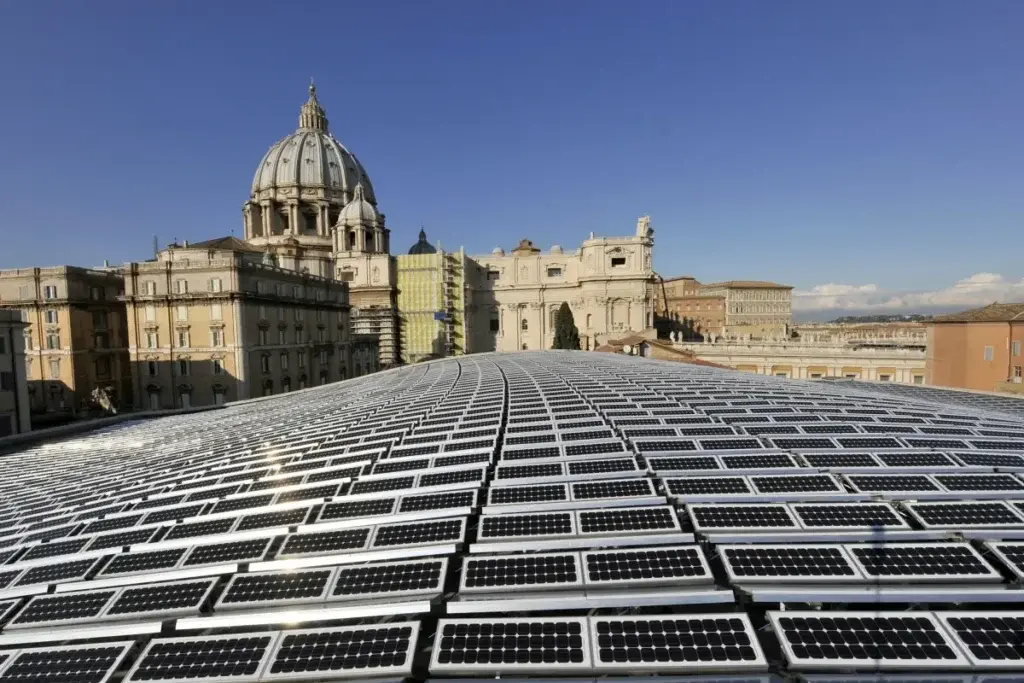
- In 2008, the Vatican installed solar panels on the Paul VI Audience Hall, one of the earliest examples of solar adoption by a national government.
- By 2019, it had banned single-use plastics, becoming one of the first states in the world to implement such a policy.
- Through the Ecological Conversion 2030 program, it is transitioning its official fleet of vehicles to fully electric and hybrid models.
- The Vatican is also on track to recycle over 70% of its municipal waste, showing a deep commitment to circular economy principles.
All of these initiatives have been guided by a consistent philosophy: that ecological protection is a moral obligation, not just a policy preference.
A Papal Mandate for the Planet
The spiritual undercurrent driving this project comes from the leadership of both Pope Francis and his successor, Pope Leo XIV.
Pope Francis made headlines when he released Laudato Si’, his 2015 encyclical calling on humanity to protect “our common home.” He also pledged Vatican City to reach net-zero carbon emissions by 2050, long before many larger nations had even discussed the idea.
Pope Leo XIV, elected in 2024, has continued this legacy with vigor. He issued Fratello Sole - a motu proprio (papal decree) focused entirely on climate action and has made regular public statements urging nations to abandon fossil fuels in favor of renewable energy. His personal blessing of the Santa Maria di Galeria site in mid-2025 underscored the symbolic and theological importance of the project.
Why the Vatican’s Move Matters Globally
This is not just about solar panels and carbon credits. The Vatican’s carbon-neutral goal resonates far beyond its 44 hectares of land and 800 residents.
1. Moral Leadership: As the heart of the Catholic Church, the Vatican’s choices carry ethical weight for 1.3 billion Catholics worldwide. This project serves as a moral call to action, urging individuals, institutions, and governments to align policy with planetary stewardship.
2. Diplomatic Influence: The Holy See holds observer status at the United Nations and participates in major global forums. Its carbon neutrality goal gives it newfound credibility in pushing for stronger global climate commitments.
3. A Scalable Blueprint: The Vatican’s approach combining renewable energy infrastructure, sustainable land use, and faith-based education can serve as a model for small nations, municipalities, and faith organizations worldwide.
A Small State with a Big Message
In becoming the world’s first carbon-neutral state, the Vatican demonstrates that climate action is not about size, it’s about willpower, vision, and leadership. It challenges larger nations to follow suit and makes clear that the moral imperative to act on climate is universal.
From solar panels to sacred texts, from ecological policy to spiritual teaching, the Vatican is building a new kind of legacy, one that may shine as brightly as the sun it now seeks to harness.
Discussion
Start the conversation
No comments yet
Be the first to share your thoughts on this article. Your insights could spark an interesting discussion!