
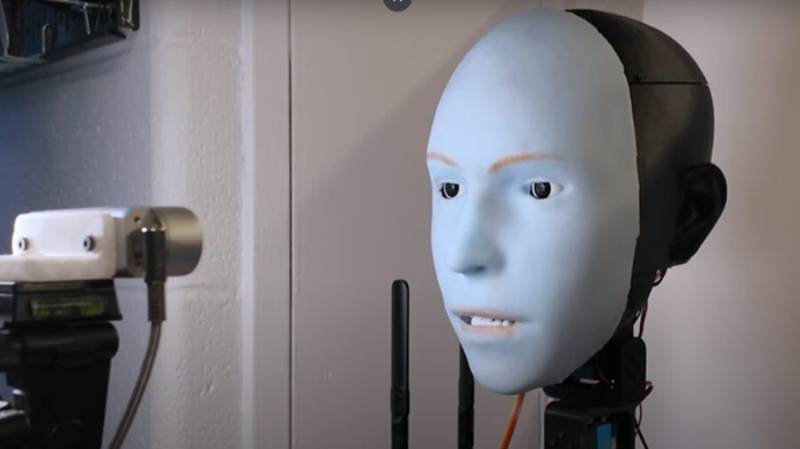
Japanese researchers have engineered lab-grown human skin that can be securely attached to robot faces, enabling realistic stretching, self-repair of minor cuts, and expressive movements like smiling. Led by Professor Shoji Takeuchi at the University of Tokyo’s Biohybrid Systems Laboratory, the work published in Cell Reports Physical Science in mid-2024, demonstrates a new way to bind living tissue to complex mechanical surfaces, bringing robots a step closer to human-like appearance and interaction.
How the smiling skin works
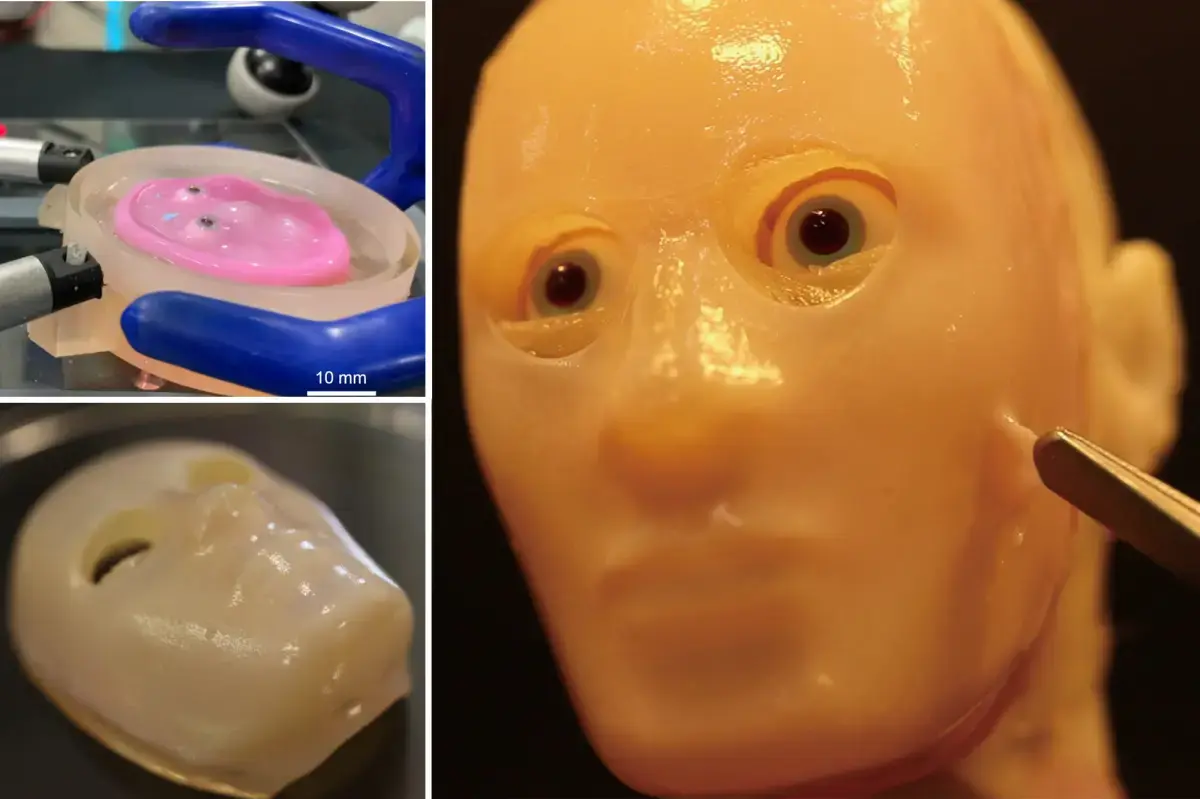
- The skin is cultivated from human cells into a dermis-like tissue and then integrated onto robotic substrates using tiny ligament-like anchors.
- These anchors are formed via V-shaped micro-perforations in the robot’s surface that are filled with collagen gel, mimicking the function of human skin ligaments.
- The result is a strong, flexible interface that resists tearing and peeling while translating actuator motion smoothly to the surface, allowing fluid facial expressions on both 2D mechanized faces and 3D facial molds.
Why it matters
- Robotics: Living, self-healing coverings can withstand wear, flex naturally, and potentially host embedded sensors, improving durability and human-robot interaction.
- Reconstructive and plastic surgery: Realistic face platforms can model facial biomechanics, aid surgical planning and training, and reduce reliance on animal or human trials.
- Cosmetic and drug research: Human-cell based skin models offer safer, more predictive testbeds for topical formulations and transdermal drug delivery.
- Aging studies: Controlled, repeatable platforms can help investigate wrinkle formation, elasticity changes, and interventions over simulated lifespans.
- Biohybrid systems: The work advances machine-biology integration, pointing toward robots that one day feel, thermoregulate, and heal like living organisms.
What’s new versus past efforts
- Traditional approaches glued pre-grown skin sheets onto rigid surfaces, which often slipped or tore over curved, moving geometries.
- The Tokyo team’s perforation-type anchoring mimics natural skin ligaments, distributing forces through collagen-filled V-grooves to maintain adhesion and allow complex, lifelike motion without visible fasteners.
- Building on earlier success with a self-healing skin on a robotic finger, the face-focused study prioritizes robust attachment and expressive control, setting the stage for whole-face self-repair tests.
Limitations
- The current appearance still reads as uncanny: epidermal layers are thin, and surface microfeatures like pores and fine wrinkles are minimal.
- Motion is driven by external actuators, which, while effective, do not yet reproduce the nuance of human facial musculature.
- Sensory capabilities (touch, temperature, pain), moisture/sweat management, and thermoregulation are not yet integrated.
Roadmap and next steps
- Thicker, more stratified skin: Enhance the epidermis and dermis for realism and durability.
- Vascularization: Add microvasculature to nourish the tissue, extend longevity, and support more autonomous self-healing.
- Innervation and glands: Integrate nerves for sensation and sweat/sebaceous glands for moisture and barrier function.
- Muscle-driven expressions: Explore cultured muscle actuators or advanced soft robotics for fine-grained, humanlike facial movements.
- Full-face healing trials: Validate consistent self-repair across complex facial geometries, not just localized regions.
Big picture
By recreating skin’s ligament-like anchoring in a synthetic-mechanical context, Takeuchi’s team has solved a crucial interface problem that has limited lifelike robot faces for decades. The approach transforms living skin from a delicate veneer into a functional, dynamic layer that can move, endure, and heal, laying groundwork for service robots with safer, more natural interactions and for high-fidelity medical and cosmetic research platforms that faithfully model human skin.
Discussion
Start the conversation
No comments yet
Be the first to share your thoughts on this article. Your insights could spark an interesting discussion!