
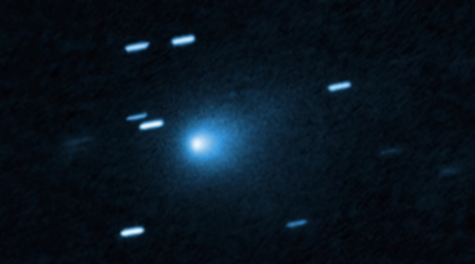
Humanity’s quest to understand the cosmos was shaken again this year with the arrival of a truly bizarre alien, 3I Atlas, the third confirmed interstellar object to pass through our solar system. As astronomers scramble to study its fleeting visit, 3I Atlas has challenged many of our established ideas about comets, cosmic chemistry, and galactic travel.
What is 3I Atlas?
3I Atlas first caught our attention on July 1, 2025. It was discovered by the Asteroid Terrestrial Impact Last Alert System, a global network designed to spot dangerous objects in our skies. Classified as an “interstellar comet,” Atlas is on a hyperbolic path. This means it’s not bound by the Sun’s gravity and will never return once it leaves the solar system. Since its initial identification, nearly 100 research papers have been published, but Atlas remains one of astronomy’s biggest enigmas.
Unique Features That Defy the Norm
- Size & Speed: To put it in perspective, Atlas absolutely dwarfs its interstellar predecessors, ‘Oumuamua (400m) and Borisov (1km), by possibly stretching up to 5.6km across. It’s also the fastest object we’ve ever tracked in the solar system, clocking in at about 58 km/s, almost twice the velocity of the earlier visitors.
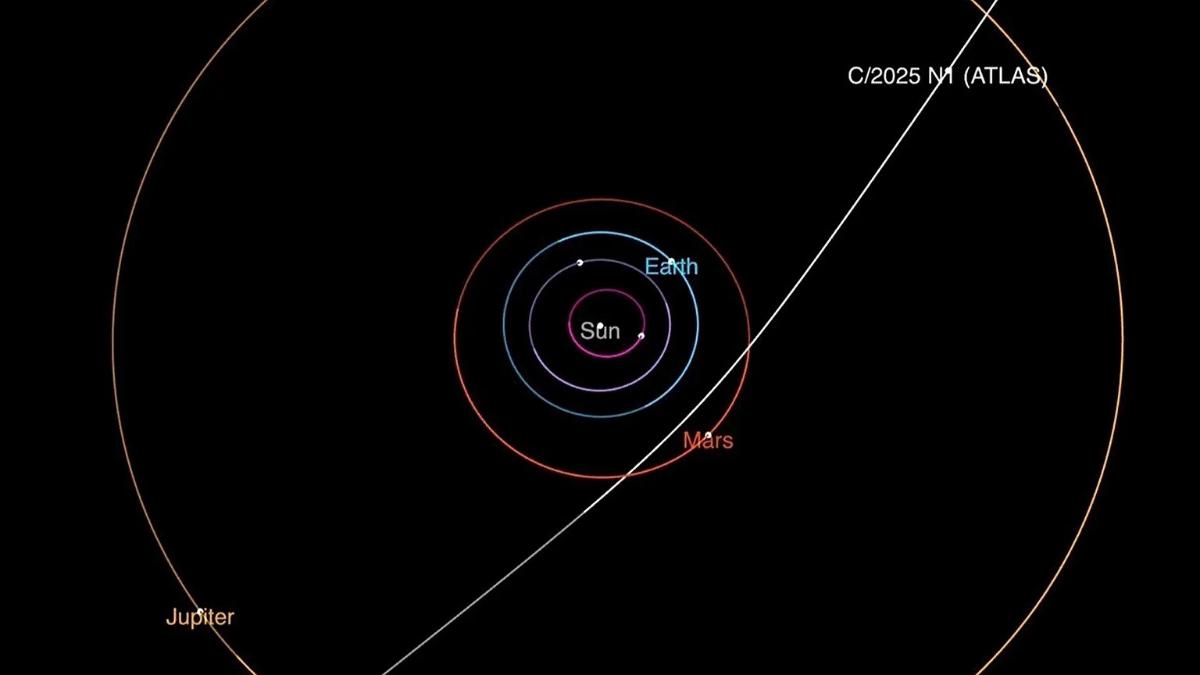
- Perihelion & Activity: Atlas made its closest approach to the Sun, or its “perihelion,” on October 29, 2025. It passed just 1.4 astronomical units away, which is inside Mars’s orbit. This intense solar heat blasted material off Atlas, creating the spectacular coma and tail typical of a comet.
- Perfect Alignment: Most objects in our solar system travel close to a plane known as the “ecliptic.” Atlas hit our solar system with a nearly perfect side-on trajectory, just 3° off this disk, which is a striking cosmic coincidence. While ‘Oumuamua and Borisov approached from the general direction our solar system is moving, Atlas arrived almost like a “T-bone” side collision.
Out-of-This-World Chemistry
The composition of Atlas is what really makes it stand out.
- CO₂ Dominance: Unlike our local comets, which are made mostly of water ice, Atlas exhibited an abnormally high ratio of carbon dioxide ice (CO₂). It had about eight times more CO₂ than water! This allowed its coma, the cloud around its nucleus, to form much farther from the Sun (over 5 AU) than is typical, as CO₂ turns to gas at colder temperatures. As Atlas got closer, water vapor surged, unexpectedly producing more than even regular comets at similar distances.
- Unusual Metals: During early observations, prestigious telescopes found nickel in Atlas’s coma but almost no iron. This was strange because both metals are usually found together, having originated in the cores of ancient supernovae. Only later did iron appear, and the nickel-to-iron ratio became less weird as Atlas heated up near the Sun.
- Extreme Polarization: Atlas exhibited the most negative polarization of any object ever found, defying the usually positive polarization of its predecessors. This hint suggests not all solar systems produce the same cosmic “normal.”
A Tail Facing Sunward?
You read that right! Initially, Atlas’s tail pointed toward the Sun. This was probably due to the weak solar wind at its distance and the early coma formation caused by its high CO₂ content. Later, as the comet approached the Sun, its tail shifted to the expected direction, which is away from the Sun.
Galactic Origins and an Ancient Age
Astronomers traced Atlas’s path back 10 million years and found it came from the thick disk region near the core of the Milky Way. This sparsely populated zone may mean Atlas is far older than our solar system, possibly an incredible 7.6 billion years old. It crossed the orbits of 93 stars in that time, never getting closer than 0.3 light-years to any of them.
Cosmic Close-Ups & Future Observations
While the Sun’s glare blocked Earth’s view at perihelion, Martian rovers and orbiters managed to snap historic photos as Atlas passed just 0.19 AU from Mars. We expect to get more images after December 2025. Then, in March 2026, Atlas will pass close to Jupiter, letting NASA’s Juno probe take one last look before it speeds back into interstellar space forever.
Why Does 3I Atlas Matter?
3I Atlas exposes the amazing diversity of cosmic chemistry. It challenges how we classify and understand comets, planetary system formation, and galactic migration. Its strange trajectory, ancient age, and exotic composition offer vital clues about the types of objects drifting among the stars and remind us how much we still have to learn.
As Atlas races back into the void, the data it leaves behind will fuel new insights and debates for years. When the next mysterious visitor appears, we’ll be better equipped, but no less awed, by the universe’s secrets.
Discussion
Start the conversation
No comments yet
Be the first to share your thoughts on this article. Your insights could spark an interesting discussion!