
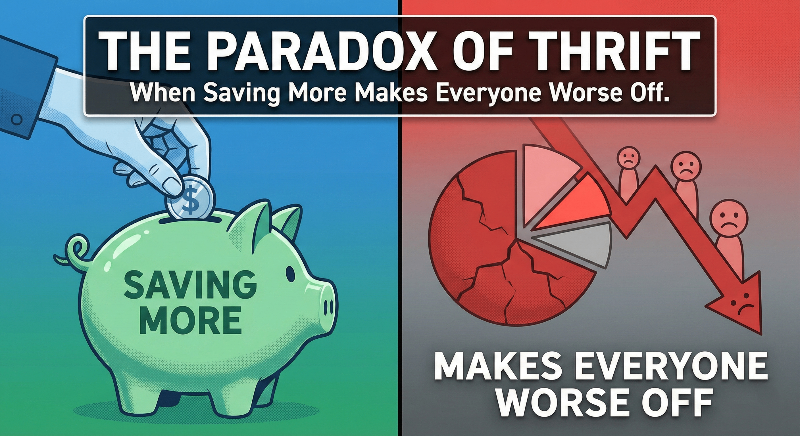
Economics is full of counterintuitive ideas, but few are as striking as the Paradox of Thrift. At its core, this concept challenges a belief most people consider absolute: saving money is always good. While this is true for an individual, it becomes deeply problematic when everyone decides to save at the same time. To understand this better, let’s step into a hypothetical city where this paradox unfolds in real time.
Spendopolis: A City Built on Spending
Imagine a bustling city called Spendopolis. Business is thriving, cafés are crowded, and money moves smoothly through every corner of the economy. People earn, spend, and keep the cycle alive.
Then, almost overnight, a rumor spreads:
“The future looks uncertain. It’s better to save more money.”
People react quickly. In fear of economic trouble, they cut down their daily expenses. Individually, this seems reasonable—saving for safety is a sensible decision. But collectively, the results are far from ideal.
How Saving More Can Hurt the Economy
The chain reaction begins in places no one anticipates:
1. Consumers stop buying non-essential items.
Your morning coffee is the first thing sacrificed. The café’s sales drop. They reduce working hours or lay off staff.
2. Businesses earn less.
Shopkeepers, earning less revenue, cut back on purchasing raw materials. Suppliers, in turn, face declining orders.
3. Suppliers downsize.
Factories reduce production, delay investments, or let go of employees.
4. Unemployment rises.
With fewer jobs and lower incomes, people spend even less, deepening the contraction.
What started as a collective attempt to save more ends up shrinking the very incomes people depend on to save.
The Core Paradox
The paradox lies in this outcome:
When everyone attempts to save more at the same time, total savings in the economy may actually fall. Why? Because savings are a portion of income. When income collapses due to reduced spending, even if individuals want to save more, they now have less money to save. The act of protecting oneself collectively ends up harming everyone.
Why This Happens: The Keynesian Explanation
The Paradox of Thrift was articulated by economist John Maynard Keynes, who argued that:
- One person’s spending becomes another person’s income.
- When many people reduce spending, aggregate demand falls.
- Falling demand leads to job cuts, lower production, and reduced incomes.
- Lower incomes mean lower actual savings, despite higher intentions to save.
This is why governments often step in during recessions—through stimulus, public spending, and incentives—to counteract a sudden drop in consumption.
Saving: Good or Bad? The Balanced View
Saving is not the enemy. It is essential for financial security, investment, and long-term growth.
The problem arises only when everyone simultaneously chooses to drastically increase their savings during uncertain times.
Healthy economies require a balance:
- Individuals should save responsibly.
- Businesses and governments must ensure that spending continues flowing through the system.
- Consumer confidence must remain strong enough to sustain demand.
Without this balance, even the most rational personal decisions can collectively create economic instability.
Conclusion
The Paradox of Thrift is a powerful reminder that economies are interconnected systems. Individual actions, when multiplied across millions, can produce outcomes far different from what anyone intends.
The message is simple yet profound:
Saving is wise when done individually and moderately.
Saving becomes harmful when done collectively and excessively.
Understanding this paradox helps us appreciate why economic policy often encourages spending during downturns and why stability depends not only on individual prudence but on collective participation.
Discussion
Start the conversation
No comments yet
Be the first to share your thoughts on this article. Your insights could spark an interesting discussion!