
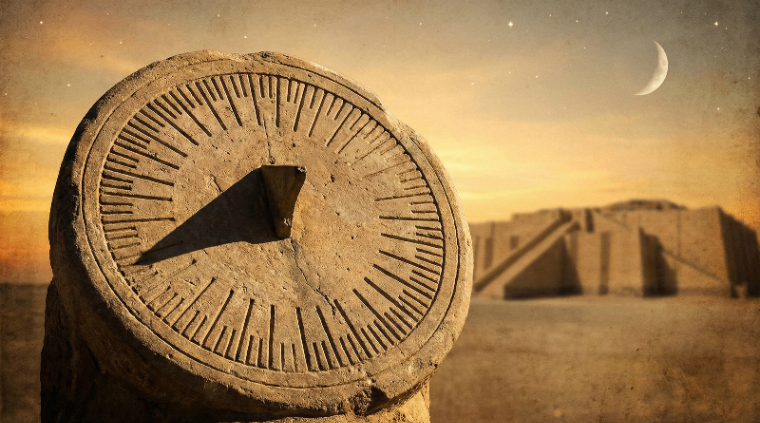
Time feels natural to us, we check the clock, count the minutes, and move on with our day. But behind this simple act lies a surprisingly old and intelligent system. One of the most fundamental units of time we use is the minute, and although it seems ordinary, its structure is rooted in a history that spans thousands of years.
What Exactly Is a Minute?
A minute is a standard unit used to measure short intervals of time, especially in everyday life. We use minutes for things like:
- Timing a voice note
- Heating food in the microwave
- Estimating how long a task will take
- Waiting at a traffic signal
Scientifically, 1 minute is equal to 60 seconds, no matter where you are in the world.
Why 60 Seconds? A System Older Than Civilization Itself
This is where things get interesting. The choice of 60 is not random. It traces all the way back to the ancient Babylonians, around 2000–1500 BCE, who used a sexagesimal (base-60) number system.
Why base-60?
Historians believe they adopted it because:
- 60 has many divisors (2, 3, 4, 5, 6, 10, 12, 15, 20, 30, 60).
- This makes calculations—especially fractions—extremely convenient.
- Their mathematical and astronomical systems relied heavily on precise divisions.
- The Sumerians before them already used a combination of base-10 and base-60 counting methods.
This base-60 system became so influential that later civilizations, including the Greeks and medieval scholars, retained it for astronomy and mathematics. Eventually, it became the foundation for how we measure time and angles.
How Long Does a Minute Feel?
While a minute is always exactly 60 seconds, its perception varies wildly:
- Waiting for a call? The minute feels painfully slow.
- Running late? It disappears before you know it.
- Meditating? It feels peaceful and stretched.
- Watching a progress bar stuck at 99%? Feels like eternity.
This psychological difference occurs because our brain processes time based on attention and emotion—not on actual seconds.
Where Else Do We Use Base-60?
The influence of the Babylonian system survives in many areas:
- 360 degrees in a circle (6 × 60)
- 60 minutes in a degree for precise measurements
- 60 seconds in a minute
- 24 hours in a day (which also links back to Egyptian timekeeping)
It’s one of the few ancient mathematical ideas that modern technology still respects.
Why This Matters Today
Even in an age of atomic clocks and nanosecond precision, we still organize time using a system invented millennia ago. That shows the remarkable durability of human ideas—and how much of our modern world is built on ancient logic. Understanding why a minute has 60 seconds is more than trivia; it’s a glimpse into the mathematical intelligence of civilizations long gone and the continuity of human knowledge over time.
Discussion
Start the conversation
No comments yet
Be the first to share your thoughts on this article. Your insights could spark an interesting discussion!