
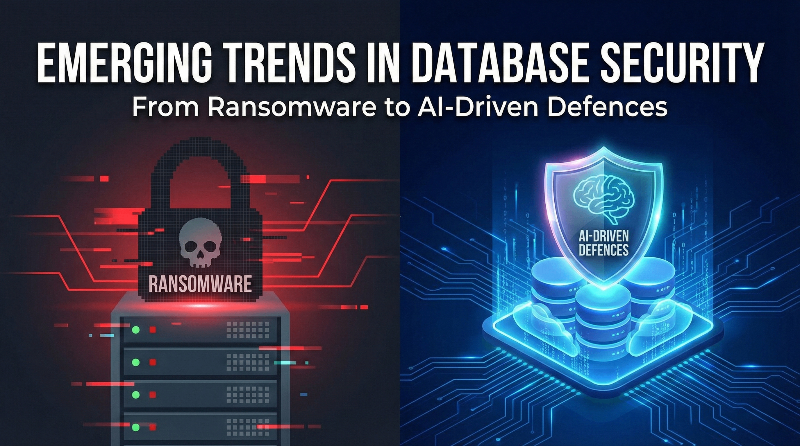
In today’s digital economy, your database is not just another backend component. It is the crown jewel.
Customer identities, payment records, health data, trade secrets, analytics models, operational logs — everything that defines organizational value lives inside structured data systems. And attackers know it.
Recent industry analyses consistently show breach costs exceeding 5 million USD per incident in many cases. Ransomware is rising. Cloud misconfigurations continue to expose sensitive data. Detection timelines are improving but still often measured in weeks. And insiders, whether malicious or careless, remain a persistent risk.
This article breaks down how database threats have evolved, what attack patterns dominate today, and which advanced mitigation strategies are proving most effective.
What “Database Security” Actually Means
Database security is not just setting a password on a DB server. It is the complete framework of technologies, processes, and policies used to protect databases against:
- Unauthorized access
- Data leakage or exfiltration
- Tampering and corruption
- Service disruption
- Accidental misuse
At its foundation lies the CIA triad:
Confidentiality
Ensuring only authorized users can access data. Achieved through encryption, access control, masking, and strong authentication.
Integrity
Preventing unauthorized or unintended data modification. Enforced via constraints, logging, auditing, and controlled permissions.
Availability
Ensuring systems remain accessible even during failures or attacks. Supported by redundancy, backups, failover mechanisms, and DDoS protection. Every modern database security architecture must protect all three simultaneously. Neglect one, and the entire system weakens.
How Database Threats Evolved
Understanding the evolution of threats explains why older controls still matter and why new gaps have appeared.
Phase 1: Physically Isolated Systems
Early databases were:
- Offline or on isolated networks
- Physically protected
- Used mainly by governments and large institutions
Threats focused on physical access and early logical inference attacks. Security models such as Bell-LaPadula emphasized strict hierarchical classification. Security was structural and centralized.
Phase 2: Client–Server and Network Expansion
As databases became shared across departments and accessed over networks:
- Human error increased
- Access control complexity grew
- Inference attacks became more sophisticated
This period saw the rise of DAC, MAC, and RBAC models to formalize authorization. Connectivity introduced risk.
Phase 3: Internet and Web Applications
With the rise of web applications and e-commerce:
- SQL injection became dominant
- Insider threats increased
- Organized cybercrime emerged
Encryption, anonymization, and stronger application-layer protections became necessary. Databases were no longer internal assets. They were public-facing targets.
Phase 4: Cloud, APIs, and APTs
Today’s environment includes:
- Cloud-native databases
- API exposure
- SaaS platforms
- Hybrid and multi-cloud architectures
Threats now include:
- Advanced Persistent Threats
- Ransomware and double extortion
- Cloud misconfigurations
- Supply-chain compromises
Attackers no longer break doors. They blend in and move laterally.
What the Data Shows: Breach Trends
Recent multi-year breach analyses reveal consistent patterns.
Credential Theft Still Dominates
Phishing and stolen credentials remain leading initial access vectors. Password reuse and credential stuffing continue to compromise financial, retail, and cloud systems. Identity is now the primary attack surface.
Ransomware Is Evolving
Ransomware accounts for a substantial portion of breaches in recent years. The shift to double extortion means attackers encrypt data and threaten public exposure. Backups alone are no longer sufficient defense.
Cloud Misconfiguration Is a Structural Weakness
Misconfigured storage buckets, exposed APIs, and weak IAM policies account for a large share of modern breaches. Cloud is not insecure by default. Poor configuration is.
Detection Is Improving, But Not Fast Enough
AI-driven monitoring has reduced detection times in many sectors. However, many breaches still remain undetected for extended periods, increasing damage and cost. Speed is security.
Industry-Specific Risk Patterns
Threats are universal. Attack paths are not.
Healthcare
Ransomware disrupts critical care systems. Insider misuse remains high due to broad access needs.
Finance
Credential stuffing, phishing, API abuse, and fraud dominate.
Education and Research
Cyber espionage targeting intellectual property and research data.
Retail
Shift from PoS malware to web application and bot-driven fraud.
Manufacturing
High concentration of espionage-driven breaches targeting designs and supply chains. Security strategies must reflect data value and sector exposure.
Emerging Threat Categories
Several threat classes are accelerating.
1. Ransomware and Double Extortion
Human-operated campaigns use legitimate administrative tools to evade detection. Payment pressure increases through public data leak threats.
2. Insider Threats and Shadow Data
Unmanaged copies of sensitive data expand risk. Malicious insiders remain among the most expensive breach categories.
3. Cloud-Specific Identity Attacks
Compromised cloud identity systems can expose entire environments. Hybrid architectures increase visibility gaps.
4. AI-Powered Cyberattacks
Generative AI enables:
- Highly convincing phishing
- Automated reconnaissance
- Polymorphic malware
Adversary-in-the-middle phishing specifically targets MFA workflows and privileged accounts.
5. Supply Chain Compromise
Compromising vendors provides indirect access to downstream databases. Third-party risk is now a first-order concern.
6. Business Email Compromise
Executive impersonation targeting administrators enables privileged escalation.
7. DDoS as Diversion
DDoS attacks increasingly act as smokescreens for deeper intrusions.
Building a Multi-Layered Defence
There is no single fix. Effective database security requires layered reinforcement.
Strengthened Authentication
- Multi-Factor Authentication
- Passwordless authentication
- Hardware security keys
- Certificate-based authentication
- Biometric verification
Identity hardening is foundational.
Granular Access Control
- RBAC for scalable permission models
- ABAC for dynamic contextual enforcement
- MAC for high-security environments
- Just-in-Time privilege elevation
Least privilege must be operational, not theoretical.
Advanced Encryption
- Encryption at rest and in transit
- Homomorphic encryption for secure computation
- Tokenization and data masking
- Strong key management
- Evaluation of post-quantum cryptography
Encryption must extend beyond compliance checkboxes.
Cloud Security Modernization
- Continuous configuration audits
- Automated policy validation
- Zero-trust architecture
- Micro-segmentation
- Cloud-native monitoring
Implicit trust is obsolete.
AI-Driven Detection and Response
- Behavioural baselining
- Anomaly detection
- Automated containment playbooks
- Rapid isolation of compromised accounts
AI reduces breach lifecycle time when properly integrated.
Proactive Vulnerability Management
- Automated patching
- Regular scanning and penetration testing
- Bug bounty integration
Waiting for alerts is too late.
Insider Risk Controls
- Database activity monitoring
- Privileged Access Management
- Session recording and approval workflows
Visibility is deterrence.
Recovery and Resilience
- Encrypted offline backups
- Geographically distributed redundancy
- Tested disaster recovery plans
- Practiced incident response drills
Preparation determines impact.
Where Database Security Is Heading
Two dominant themes define the future.
AI Arms Race
Both attackers and defenders will increasingly rely on AI. Adversarial AI and AI-targeted attacks will rise.
Quantum Readiness
Quantum computing threatens current cryptographic standards. Long-term sensitive data must begin transition planning toward quantum-resistant schemes. Database security is becoming adaptive, intelligence-driven, and continuous. Static compliance frameworks will not survive dynamic threats.
Final Thoughts
Databases sit at the center of modern digital life. The threat landscape targeting them is expanding in complexity and sophistication. Ransomware, insider misuse, cloud misconfiguration, supply-chain compromise, and AI-driven attacks are converging on the same objective: your data.
The organizations that endure will not rely on a single defensive control. They will build layered, intelligence-enhanced architectures that combine identity security, encryption, zero trust, behavioural analytics, proactive vulnerability management, and tested recovery strategies. Database security is no longer a checklist. It is an evolving discipline. And in a data-driven world, resilience is competitive advantage.
For a deeper technical analysis, detailed data trends, and full references, you can read the complete research paper here: https://www.witwaves.in/journal/article/3fb2e310-0b0c-402c-a899-191855639a02
Discussion
Start the conversation
No comments yet
Be the first to share your thoughts on this article. Your insights could spark an interesting discussion!